Why Are New York Bagels So Good? The Real Reasons
- Why are New York bagels so good?
- What makes a New York bagel different?
- Is New York tap water really the secret?
- How are New York-style bagels made?
- Why does boiling change a bagel?
- Why do fresh bagels matter so much?
- How much of the reputation comes from culture?
- Can a great New York-style bagel exist elsewhere?
- Sources
Why are New York bagels so good?
New York bagels earn their reputation from a combination of dough structure, fermentation, shaping, a water bath before baking, and a city culture that values them fresh. The tap water may affect a baker's formula, but it does not confer a geographic monopoly on chew. There is also no single legally defined New York recipe: high-gluten flour, barley malt, an overnight cold proof, and a malted boil are common choices, not requirements used identically by every bakery.
The compelling part is not a secret ingredient; it is a set of process decisions that produce a tight crumb, resilient chew, and glossy crust.
What makes a New York bagel different?
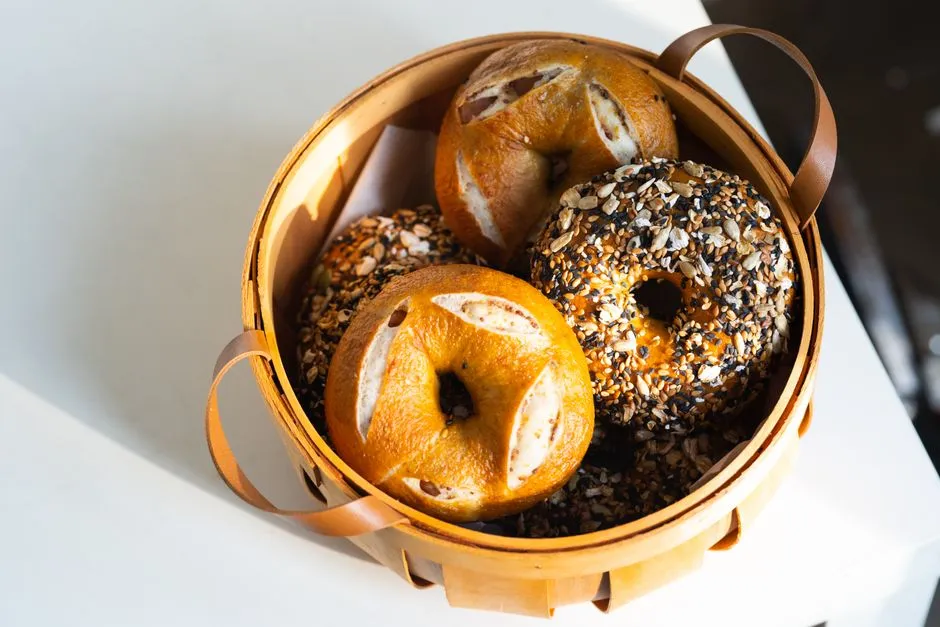
The familiar target is a compact, hefty ring with a dense, springy interior and a browned crust that resists before yielding. Blisters, seams, malt flavor, and hole size vary.
The process can be understood through four useful levers:
| Lever | What it can change | What varies |
|---|---|---|
| Strong flour and relatively stiff dough | Gluten structure, tight crumb, and chew | High-gluten flour is common for an intense chew, but bread or all-purpose flour can work in a balanced formula |
| Fermentation | Flavor, dough handling, and the production schedule | Some bakers cold-proof shaped rings overnight; others use bulk fermentation, a preferment, or a shorter schedule |
| Water bath | Surface starch, sheen, crust, and final volume | Time and bath additions vary; malt is one option, not a universal ingredient |
| Hot bake | Browning and the final crust | Some shops use damp bagel boards and flip the rings; pans and other setups also exist |
King Arthur Baking's bagel overview identifies hydration, flour protein, shaping, fermentation, and boiling as interacting variables. That is a better model than treating any one ingredient as a password.
Is New York tap water really the secret?
Water matters to dough, but the slogan is neater than the evidence.
The New York City Department of Environmental Protection says the city's supply is not chemically identical everywhere. Water from the Catskill/Delaware system is soft or slightly hard, Croton water is moderately hard, and blended areas can reach 7 grains per gallon as calcium carbonate. The citywide average is about 1.8 grains per gallon. A claim that every New York bakery receives the same uniquely soft water is therefore too simple.
Water chemistry can require a baker to adjust a formula. It does not explain why skilled bakers outside the city make excellent New York-style bagels, or why two bakeries using the same municipal supply can produce different results. Modernist Cuisine's bagel material puts the conclusion bluntly: the decisive variable is the baker, not the water source. That is one publication's tested conclusion, not proof that water has no effect at all.
The evidence points to a simple hierarchy:
- Formula and process directly shape the bagel.
- Water is one input within that formula.
- Location supplies history, expectations, and a market for the style, not an exclusive chemical advantage.
How are New York-style bagels made?
There is no single production sheet shared across the city, but a high-chew New York-style formula often follows five recognizable stages.
1. Mix a relatively stiff dough
Bagel dough is commonly drier than sandwich-bread dough. King Arthur gives a broad 55% to 65% hydration range in its technical overview and notes that lower hydration helps create a tight crumb and chew. High-gluten flour is a common way to build strength, although the same source explicitly says excellent bagels can be made with lower-protein flour when the other variables are balanced.
A classic formula may include flour, water, salt, yeast, and barley malt. But malt can appear in the dough, in the bath, in both, or not at all. Calling malt a common New York-style choice is accurate; calling it mandatory is not.
2. Shape the rings
Bakers commonly use one of two approaches: roll the dough into a rope and join the ends, or form a ball and open a hole through its center. The rope method can build more surface tension and leaves a seam. The punched method can produce a smoother, more even ring. Slight irregularity may signal hand shaping, but regularity does not prove industrial production.
3. Ferment the dough
An overnight cold proof is strongly associated with many respected bagel formulas. It can develop flavor and gives a bakery a wider window in which shaped bagels are ready to boil and bake. Some formulas cold-proof the shaped rings; others refrigerate the dough in bulk or use an overnight preferment.
A same-day bagel is not automatically poor, and every blister is not proof of one exact fermentation schedule. Time, temperature, flour, hydration, shaping, and handling work together.
4. Use a water bath
Boiling is the most recognizable dividing line between this style and ordinary ring-shaped bread. A 2004 bagel study compared unboiled samples with several boiling times and found smoother surface starch under microscopy after boiling; longer boiling also reduced volume and increased breaking energy in that specific formula. The result supports the mechanism, not one universal timer.
Published methods vary widely. The study tested total boils of 10, 40, and 120 seconds. King Arthur's general overview describes one or two minutes per side, while other formulas use under a minute per side. Bath additions vary too: malt, honey, salt, or an alkaline ingredient may be used, depending on the recipe. The water supplies heat and hydration to the surface; a sweetener is not what makes boiling work.
5. Bake hot
The heated surface becomes a glossy, pleasantly leathery crust as the bagel bakes. Some New York-style shops place wet rings on wooden boards lined with damp burlap and flip them partway through. That setup helps delay setting on the underside, but it is a production method, not a definition. A well-designed pan or deck-oven process can pursue the same final shape and browning.
Toppings such as sesame, poppy, or an everything blend go on while the surface is still tacky. They change the flavor, not the underlying structure.
Why does boiling change a bagel?
Boiling heats and gelatinizes starch at the surface before the oven finishes the bake. That pretreated skin contributes to the sheen and characteristic bite. The 2004 study also found that longer boiling produced less volume and greater breaking energy within its tested recipe, which helps explain why bath time can move a bagel from tender toward firmer and chewier.
The shorthand “boiled equals real, steamed equals fake” goes too far: King Arthur's bagel-shaping guide notes that most of its recipes boil bagels but one steams them, and says there is little difference in the final products. Immersion boiling remains a defining technique in many New York-style formulas, and changing that step changes the crust and volume. Whether the result is enjoyable is a taste judgment.
The same relationship between method and identity appears in a New York slice: shape alone tells only part of the story.
Why do fresh bagels matter so much?
Low-moisture breads stale quickly. King Arthur notes that bagels made with relatively stiff dough are best eaten within a few hours of baking. A busy shop can cold-hold shaped dough and bake it in waves, so fermentation scheduling and customer turnover reinforce each other.
Steady demand lets more batches move from oven to counter during the day. “Fresh” should describe the bagel in front of you, not function as a promise attached to a ZIP code.
How much of the reputation comes from culture?
Bagels reached the United States with Eastern European immigrants in the late nineteenth century and were initially concentrated in Jewish markets before becoming mainstream. The Smithsonian's history traces written records in Krakow to 1610 and describes the bagel's later movement into American mass culture. A Library of Congress history of Jewish labor also documents dedicated bagel-baker branches within New York's bakery unions.
That history helps explain generations of specialized production knowledge and an audience with firm ideas about texture and freshness. It does not mean tradition guarantees quality; individual bakeries still make individual choices.
The useful cultural claim is modest: New York supplied a durable ecosystem for the bagel. Immigration, bakery labor, neighborhood demand, and later commercialization all shaped the food now collected among the city's iconic New York foods.
Can a great New York-style bagel exist elsewhere?
Yes. A baker outside New York can choose a stiff, strong dough; shape for tension; use a cold proof or preferment; boil the rings; and bake for a deep crust. They can also adjust the formula for local flour, water, equipment, and schedule. None of that requires importing tap water.
The harder thing to reproduce is context: accumulated technique, a preferred balance of chew and tenderness, and enough demand to bake repeatedly. Those factors can exist anywhere.
Judge the crumb, crust, seasoning, and freshness rather than the postal story. Our Bagels & Delis guides use those observable qualities rather than treating one recipe as the law.
Sources
- King Arthur Baking, “The 5 elements of great bagels” — supports the interaction among hydration, flour, shaping, fermentation, boiling, freshness, and optional bath additions. Accessed September 3, 2026.
- King Arthur Baking, “How to shape bagels” — supports its comparison of boiling and steaming methods. Accessed September 3, 2026.
- New York City Department of Environmental Protection, Drinking Water FAQs — supports current source-dependent water-hardness classifications and figures. Accessed September 3, 2026.
- Modernist Cuisine, bagel master-recipe errata — supports its authors' conclusion about baker versus water source and its own recipe's cold-proof and boil choices. Accessed September 3, 2026.
- Hara et al., “Cooking Qualities of Bagels,” Journal of Cookery Science of Japan — supports the specific experiment's boiling-time, volume, breaking-energy, surface-starch, and sensory findings. Accessed September 3, 2026.
- Smithsonian Magazine, “A Brief History of the Bagel” — supports the Krakow record, Eastern European immigration, Jewish-market, and later mainstreaming history. Accessed September 3, 2026.
- Library of Congress, The Jewish Unions in America — supports the documented place of bagel bakers within New York's Jewish bakery unions. Accessed September 3, 2026.