What Is a Bialy? The Bagel Cousin Explained
- A bialy is a baked onion-centered roll
- Bialy vs. bagel at a glance
- The center is a depression, not a hole
- The bread came to New York through migration
- What a fresh bialy should feel like
- Judge the tray before choosing toppings
- How to order and eat one
- Can you make bialys at home?
- Storage is a compromise
- Order it for what it is
A bialy is a baked onion-centered roll
A bialy is a round, chewy yeast roll with a broad, thin depression in the center, traditionally filled with chopped onion and often poppy seeds. It looks related to a bagel, but the resemblance can mislead: a bialy is not boiled, has no open hole, and develops a lighter, less glossy crust in the oven.
The name points back to Bialystok in northeastern Poland. Jewish immigrants carried versions of the bread to New York, where it became part of the Lower East Side baking tradition. Today it sits naturally beside bagels at some bakeries, but it deserves to be ordered as its own thing.
Bialy vs. bagel at a glance
| Feature | Bialy | New York bagel |
|---|---|---|
| Center | Thin depression with onion filling | Open hole |
| Before baking | Shaped, proofed, and baked | Commonly cold-proofed, boiled, then baked |
| Exterior | Matte to lightly browned, often floury | Shiny, firm, and deeply chewy |
| Interior | Open, breadlike chew with a thin center | Dense, tight chew |
| Best moment | Especially fragile when fresh | Holds its character somewhat longer |
The boil is not a decorative difference. It sets the bagel's exterior before baking and helps create the compact, glossy chew discussed in why New York bagels taste different. Without that step, the bialy expands more like bread.
The center is a depression, not a hole
A baker shapes a bialy as a thick round, then presses and stretches the middle until it is thin while leaving a raised rim. The center receives chopped onion; poppy seed is a common partner. Some bakers add breadcrumbs, oil, salt, or another restrained seasoning.
The architecture matters. If the depression is too small or thick, it can spring upward and push off the topping. If it is stretched into a hole, the bread has lost its defining center. A well-made bialy has two textures in one piece: a substantial chewy rim and a thin, crisp-edged, onion-scented middle.
Not every onion bialy tastes the same. Raw onion placed directly on dough stays sharper; onion softened first becomes sweeter. A finely chopped filling integrates with the center, while large wet pieces can slide off or prevent browning. Those are bakery choices, not evidence that one version is counterfeit.
The bread came to New York through migration
Bialy's name is tied to Bialystok, although the exact breads eaten there varied across bakers and periods. What matters to the New York story is the movement of Jewish bakers and eaters from Eastern Europe to the city around the turn of the twentieth century.
The Lower East Side became the American center of the form. Like many foods now treated as permanent New York fixtures, the bialy survived because immigrant businesses baked for a community that already understood it, then introduced it to neighbors and later generations.
That history is easy to flatten into a quaint origin tale. The bialy is more specific than “old-world bread,” and its scarcity matters: it never achieved the bagel's national distribution or supermarket standardization. A fresh local bialy remains harder to find outside cities with committed bakers.
It belongs beside the immigrant foods in our guide to New York's iconic dishes, but it also demonstrates why no list of twelve can exhaust the city's food culture.
What a fresh bialy should feel like
Look for a rim with real chew but enough tenderness to compress under your fingers. The bottom should be baked through and may be crisp; the center should be thin, not gummy. The onion should smell savory and toasted rather than raw and sulfurous or blackened and bitter.
A bialy usually lacks the lacquered shine of a bagel. That matte surface is normal. Flour on the base or rim may reflect shaping and oven handling, not staleness.
Freshness is unusually important because the thin, lean roll dries quickly. A bialy at its best can be torn and eaten plain. Several hours later, splitting and toasting may restore crispness, but toast cannot completely reproduce the tender contrast of the original bake.
Judge the tray before choosing toppings
At a bakery that carries several versions, first look for a center that remains visibly lower than the rim and onion pieces that are browned but not charred black. A fully puffed center may still taste good, but it will eat more like an onion roll. A wet, pale patch can signal that the filling or dough needed more oven time.
Ask what came out most recently instead of assuming the most heavily topped option is best. Sesame, garlic, or an everything-style mixture can be enjoyable, but those additions should not erase the contrast between the thin middle and chewy edge. If a shop warms bialys by default, ask to see or taste one unheated when freshness is the point of the visit.
How to order and eat one
At a busy counter, ask which bialys are freshest and specify whether you want yours toasted. Do not assume “bialy” means a bagel flavor. It is the roll itself.
For a first taste, eat a wedge plain before adding anything. Then try:
- butter, which melts into the onion center;
- plain cream cheese;
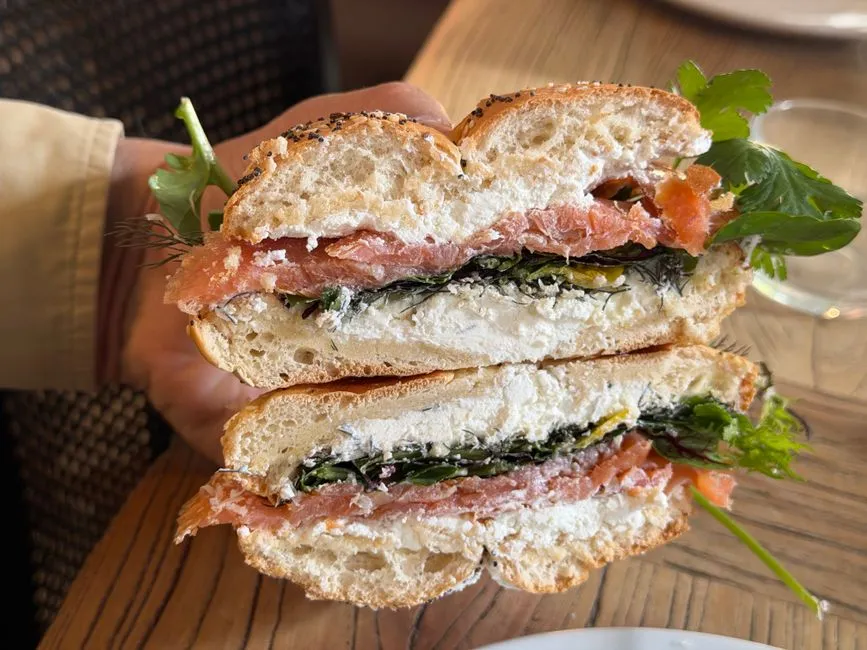
- smoked salmon with restrained garnishes;
- sliced tomato and black pepper; or
- egg and cheese for a softer breakfast sandwich.
A loaded sandwich can be good, but it makes the distinction less obvious. If the goal is to understand the bread, avoid burying the center under a towering filling on the first try.
Some counters slice a bialy horizontally like a bagel; others serve it whole. Either is workable. Because the center is thin, cutting straight through it can separate the onion topping, so use a serrated knife and steady the roll with a flat hand kept safely above the blade path.
Can you make bialys at home?
Yes. The basic process uses a lean wheat dough, fermentation, division, rounding, proofing, center shaping, topping, and a hot bake. It resembles other yeast-bread work, but the final shaping is the skill to practice.
Home bakers should resist three shortcuts:
- Do not punch a small hole. Stretch a wide, thin membrane while keeping the rim intact.
- Do not overload wet onion. Excess moisture weighs down the center and steams the dough.
- Do not boil the dough. Once boiled, the exterior moves toward bagel territory.
A preheated baking steel or stone can strengthen bottom heat, but it is optional and must be used according to its manufacturer. A heavy sheet pan can produce a good bialy. Like New York-style pizza dough, fermentation and a thoroughly preheated oven matter more than mythology about tap water.
Storage is a compromise
If you cannot eat bialys the day they are baked, cool them completely, split if desired, wrap well, and freeze. Reheat from frozen or thaw briefly and toast. Refrigeration tends to make lean bread stale faster, so it is rarely the best short-term texture choice.
Do not wrap a warm bialy tightly; trapped steam softens its base and can make the onion center wet. Perishable toppings such as cream cheese, fish, or egg need prompt refrigeration under standard food-safety guidance even when the bread itself can sit at room temperature.
Order it for what it is
A bialy is not an unfinished bagel. Its unboiled crust, breadlike rim, thin center, and baked onion filling create a quieter but distinct New York breakfast. Find one fresh, taste the center before adding a stack of toppings, and the comparison stops being abstract.
For more counter vocabulary and traditions, browse Bagels & Delis.